🔬Technical Deep Dive
Full Specifications [+]
🚀 What's Next?
⚡ Quick Commands
huggingface-cli download deepseek-ai/deepseek-math-v2 pip install -U transformers Hardware Compatibility
Multi-Tier Validation Matrix
RTX 3060 / 4060 Ti
RTX 4070 Super
RTX 4080 / Mac M3
RTX 3090 / 4090
RTX 6000 Ada
A100 / H100
Pro Tip: Compatibility is estimated for 4-bit quantization (Q4). High-precision (FP16) or ultra-long context windows will significantly increase VRAM requirements.
README








DeepSeekMath-V2: Towards Self-Verifiable Mathematical Reasoning
1. Introduction
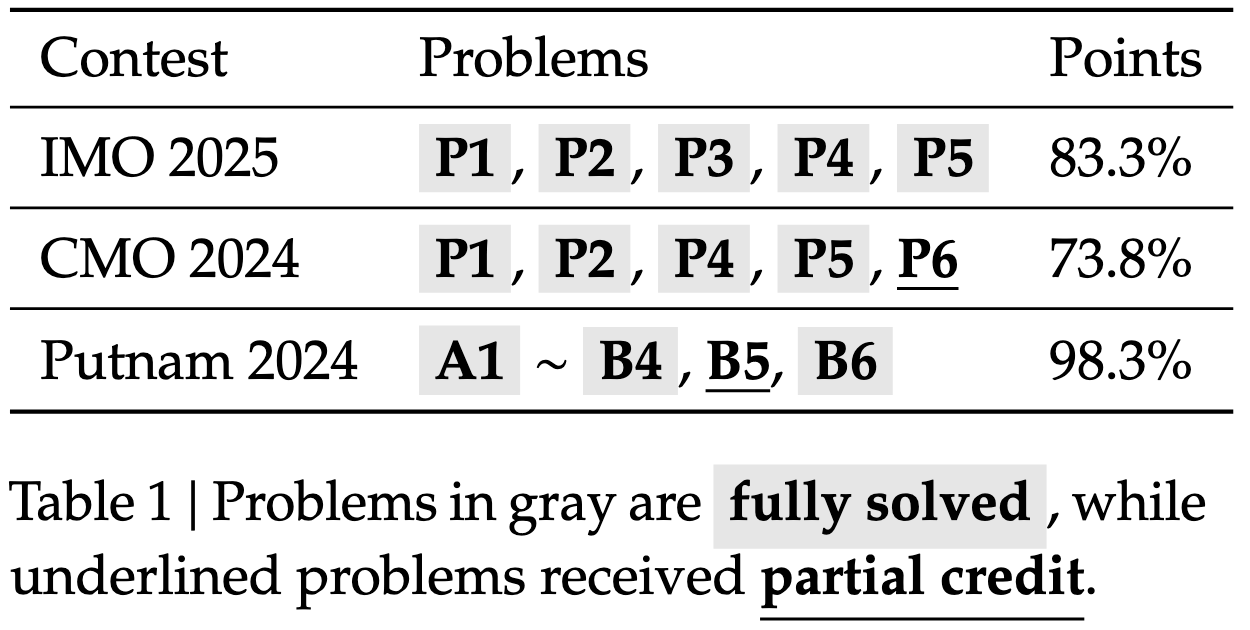
Large language models have made significant progress in mathematical reasoning, which serves as an important testbed for AI and could impact scientific research if further advanced. By scaling reasoning with reinforcement learning that rewards correct final answers, LLMs have improved from poor performance to saturating quantitative reasoning competitions like AIME and HMMT in one year. However, this approach faces fundamental limitations. Pursuing higher final answer accuracy doesn't address a key issue: correct answers don't guarantee correct reasoning. Moreover, many mathematical tasks like theorem proving require rigorous step-by-step derivation rather than numerical answers, making final answer rewards inapplicable. To push the limits of deep reasoning, we believe it is necessary to verify the comprehensiveness and rigor of mathematical reasoning. Self-verification is particularly important for scaling test-time compute, especially for open problems without known solutions. Towards self-verifiable mathematical reasoning, we investigate how to train an accurate and faithful LLM-based verifier for theorem proving. We then train a proof generator using the verifier as the reward model, and incentivize the generator to identify and resolve as many issues as possible in their own proofs before finalizing them. To maintain the generation-verification gap as the generator becomes stronger, we propose to scale verification compute to automatically label new hard-to-verify proofs, creating training data to further improve the verifier. Our resulting model, DeepSeekMath-V2, demonstrates strong theorem-proving capabilities, achieving gold-level scores on IMO 2025 and CMO 2024 and a near-perfect 118/120 on Putnam 2024 with scaled test-time compute. While much work remains, these results suggest that self-verifiable mathematical reasoning is a feasible research direction that may help develop more capable mathematical AI systems.
2. Evaluation Results
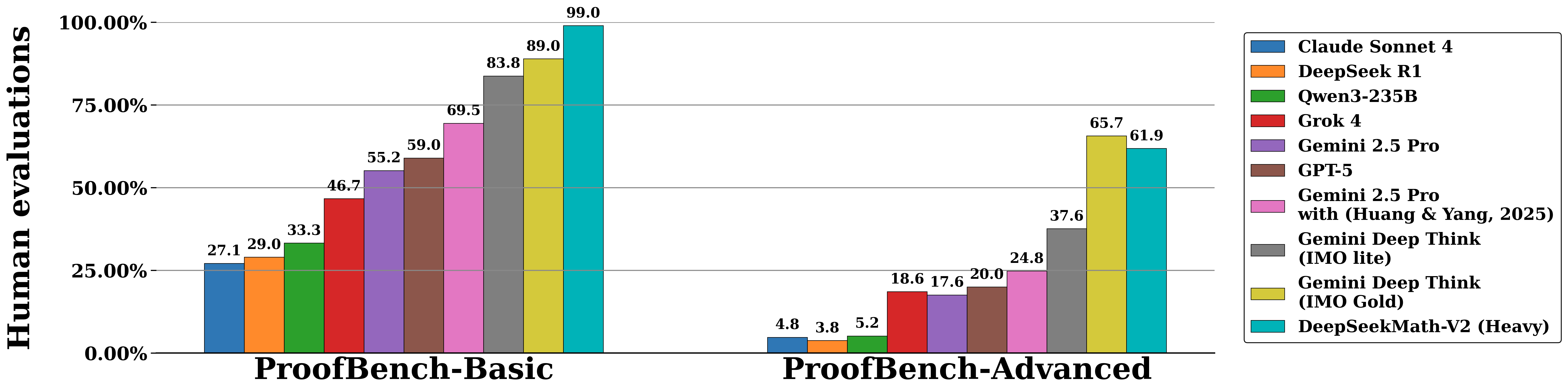
Below are evaluation results on IMO-ProofBench (developed by the DeepMind team behind DeepThink IMO-Gold) and recent mathematics competitions including IMO 2025, CMO 2024, and Putnam 2024.
IMO-ProofBench
Mathematics Competitions
4. Quick Start
DeepSeekMath-V2 is built on top of DeepSeek-V3.2-Exp-Base. For inference support, please refer to the DeepSeek-V3.2-Exp github repository.
6. License
This repository and the model weights are licensed under the Apache License, Version 2.0 (Apache 2.0).
7. Citation
@misc{deepseek-math-v2,
  author = {Zhihong Shao, Yuxiang Luo, Chengda Lu, Z.Z. Ren, Jiewen Hu, Tian Ye, Zhibin Gou, Shirong Ma, Xiaokang Zhang},
  title = {DeepSeekMath-V2: Towards Self-Verifiable Mathematical Reasoning},
  year = {2025},
}
8. Contact
If you have any questions, please raise an issue or contact us at [email protected].
5,068 chars • Full Disclosure Protocol Active
DeepSeekMath-V2: Towards Self-Verifiable Mathematical Reasoning
1. Introduction
Large language models have made significant progress in mathematical reasoning, which serves as an important testbed for AI and could impact scientific research if further advanced. By scaling reasoning with reinforcement learning that rewards correct final answers, LLMs have improved from poor performance to saturating quantitative reasoning competitions like AIME and HMMT in one year. However, this approach faces fundamental limitations. Pursuing higher final answer accuracy doesn't address a key issue: correct answers don't guarantee correct reasoning. Moreover, many mathematical tasks like theorem proving require rigorous step-by-step derivation rather than numerical answers, making final answer rewards inapplicable. To push the limits of deep reasoning, we believe it is necessary to verify the comprehensiveness and rigor of mathematical reasoning. Self-verification is particularly important for scaling test-time compute, especially for open problems without known solutions. Towards self-verifiable mathematical reasoning, we investigate how to train an accurate and faithful LLM-based verifier for theorem proving. We then train a proof generator using the verifier as the reward model, and incentivize the generator to identify and resolve as many issues as possible in their own proofs before finalizing them. To maintain the generation-verification gap as the generator becomes stronger, we propose to scale verification compute to automatically label new hard-to-verify proofs, creating training data to further improve the verifier. Our resulting model, DeepSeekMath-V2, demonstrates strong theorem-proving capabilities, achieving gold-level scores on IMO 2025 and CMO 2024 and a near-perfect 118/120 on Putnam 2024 with scaled test-time compute. While much work remains, these results suggest that self-verifiable mathematical reasoning is a feasible research direction that may help develop more capable mathematical AI systems.
2. Evaluation Results
Below are evaluation results on IMO-ProofBench (developed by the DeepMind team behind DeepThink IMO-Gold) and recent mathematics competitions including IMO 2025, CMO 2024, and Putnam 2024.
IMO-ProofBench
Mathematics Competitions
4. Quick Start
DeepSeekMath-V2 is built on top of DeepSeek-V3.2-Exp-Base. For inference support, please refer to the DeepSeek-V3.2-Exp github repository.
6. License
This repository and the model weights are licensed under the Apache License, Version 2.0 (Apache 2.0).
7. Citation
@misc{deepseek-math-v2,
  author = {Zhihong Shao, Yuxiang Luo, Chengda Lu, Z.Z. Ren, Jiewen Hu, Tian Ye, Zhibin Gou, Shirong Ma, Xiaokang Zhang},
  title = {DeepSeekMath-V2: Towards Self-Verifiable Mathematical Reasoning},
  year = {2025},
}
8. Contact
If you have any questions, please raise an issue or contact us at [email protected].
📝 Limitations & Considerations
- • Benchmark scores may vary based on evaluation methodology and hardware configuration.
- • VRAM requirements are estimates; actual usage depends on quantization and batch size.
- • FNI scores are relative rankings and may change as new models are added.
- ⚠ License Unknown: Verify licensing terms before commercial use.
- • Source: Unknown
Cite this model
Academic & Research Attribution
@misc{hf_model__deepseek_ai__deepseek_math_v2,
  author = {deepseek-ai},
  title = {undefined Model},
  year = {2026},
  howpublished = {\url{https://huggingface.co/deepseek-ai/deepseek-math-v2}},
  note = {Accessed via Free2AITools Knowledge Fortress}
}AI Summary: Based on Hugging Face metadata. Not a recommendation.
🛡️ Model Transparency Report
Verified data manifest for traceability and transparency.
🆔 Identity & Source
- id
- hf-model--deepseek-ai--deepseek-math-v2
- author
- deepseek-ai
- tags
- transformerssafetensorsdeepseek_v32text-generationconversationalbase_model:deepseek-ai/deepseek-math-v2base_model:quantized:deepseek-ai/deepseek-math-v2license:apache-2.0endpoints_compatiblefp8region:us
⚙️ Technical Specs
- architecture
- DeepseekV32ForCausalLM
- params billions
- 685.4
- context length
- 4,096
- vram gb
- 516.5
- vram is estimated
- true
- vram formula
- VRAM ≈ (params * 0.75) + 2GB (KV) + 0.5GB (OS)
📊 Engagement & Metrics
- likes
- 644
- downloads
- 9,831
Free2AITools Constitutional Data Pipeline: Curated disclosure mode active. (V15.x Standard)